
FRP Rebar vs Steel Rebar, and Which Resin to Use: Epoxy, Vinyl Ester and Polyester
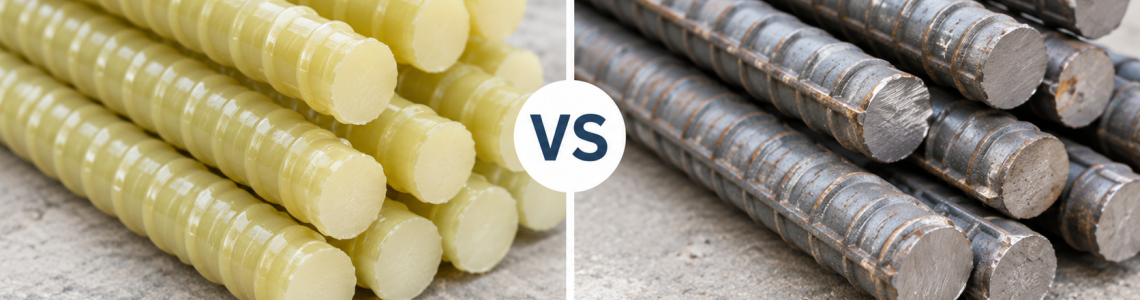
Steel rebar rusts. In coastal areas, near chemical plants and in water-retaining structures, that rust expands, cracks the concrete and shortens the life of the structure. This is why more projects now look at FRP rebar. But choosing FRP rebar is only half the job. The resin that holds the fibres together decides how well the bar performs. This guide compares FRP rebar with steel and explains which resin fits which project.
What is FRP Rebar?

FRP rebar is a reinforcing bar made from glass (or sometimes carbon or basalt) fibres bound in a resin. Most bars are made by pultrusion, where fibres are pulled through a resin bath and then through a heated die. The surface is usually ribbed or sand-coated so that it grips the concrete.
FRP Rebar vs Steel Rebar
Two points surprise most designers. First, FRP rebar is strong but less stiff, so deflection and crack width often decide the design, not strength. Second, it has no yield point, so designs follow specific codes such as ACI 440.1R or CSA S807, and bars are commonly tested to ASTM D7957.
Where FRP Rebar Makes Sense
Jetties, seawalls and coastal roads
Water treatment plants, tanks and drains
Chemical and fertiliser plants
Tunnels, metro lines and areas near electrical or magnetic equipment
Bridge decks and parking structures exposed to salts
For ordinary inland buildings, steel usually remains cheaper than FRP rebar.
Resin Selection for FRP Rebar
The resin matters because it protects the glass fibres from alkali in concrete and water. Think of frp resin as the part that decides durability.
For most resin frp material used in concrete, vinyl ester is the common balance between cost and durability. Epoxy is picked when higher bond, strength or heat resistance is needed. Polyester suits temporary or low-demand uses, but it is not a safe choice where bars sit in wet alkaline concrete for decades. Whichever frp resin you shortlist, ask for alkali resistance test data.
Epoxy Resin Composite Material and Carbon Fiber Resins
An epoxy resin composite material pairs epoxy with glass, carbon or basalt fibres. The result has high strength per kilogram, good fatigue life and little shrinkage. Carbon fiber resins are mostly epoxy-based because epoxy bonds well to carbon and holds its properties under load and heat. Carbon systems are used for structural strengthening, wraps and plates more than for general FRP rebar, as the cost is much higher.
Resin Infusion for Larger Parts
Pultrusion suits straight bars. For larger or curved parts such as grating, tank sections and structural profiles, resin infusion is common. Dry fibres are laid in a mould, sealed under a bag, and resin is drawn in by vacuum. It reduces voids and gives better fibre content than hand layup. Low-viscosity resin is important here, so ask your supplier about infusion grades.
FRP Coating and Surface Protection
An frp coating or gel coat on the surface of fabricated parts protects against UV light, abrasion and weather. For rebar that is buried in concrete, UV is not a worry, but bars stored in open yards for months should be covered. Exposed FRP profiles, on the other hand, need a UV-resistant surface layer. Any resin frp material that will sit outdoors needs this kind of protection.
Rebar Epoxy: Two Different Meanings
People searching for rebar epoxy usually mean one of two things.
1. Epoxy-coated rebar
This is steel rebar with a fusion-bonded epoxy coating, typically 175 to 300 microns thick as per ASTM A775. It slows corrosion, but the coating can be damaged during transport, bending and placing. Damaged spots must be repaired with a patching compound, and bars should be handled with padded slings.
2. Epoxy for anchoring rebar
Here epoxy is used to fix new bars or dowels into existing concrete. The method is simple, but it must be done properly:
Drill the hole to the diameter and depth in the design.
Clean out dust with a brush and compressed air, and repeat the cycle.
Fill the hole with epoxy from the bottom.
Insert the bar with a twist and let it cure.
Check the cure time at your site temperature, and do not load the bar early. Anchoring epoxy is a different product from the resin that is used to make FRP bars.
Choosing an FRP Materials Company

When comparing a frp materials company, look at more than price:
Do they supply data sheets with cure schedules and mechanical values?
Can they supply frp resin in the right viscosity for pultrusion or infusion?
Do they have test reports to relevant standards?
Can they provide a small trial quantity?
Is technical support available during trials?
Talk to the Technical Team
If you are comparing resins for FRP rebar or composite parts, share your process (pultrusion, infusion or hand layup), cure conditions and end use. MB Enterprises can help you narrow down the resin options.
FAQs
1. Is FRP rebar stronger than steel?
In tension, glass bars are often two to three times stronger, but they are less stiff, so crack width and deflection limit the design.
2. Which resin is best for FRP rebar?
Vinyl ester is the most common resin frp material for glass bars because of its alkali resistance. Epoxy is used where higher bond and performance are needed.
3. Can FRP rebar be bent on site?
No. Bends and stirrups are made in the factory, so the bar schedule must be final before ordering.
4. What does rebar epoxy mean?
It can mean epoxy-coated steel rebar or epoxy adhesive used to anchor rebar into concrete.
5. Is FRP rebar more expensive than steel?
Upfront, yes. Over the life of a coastal or chemical structure, lower maintenance often balances this.
6. Where is resin infusion used?
For larger FRP parts such as tank sections, profiles and panels, where vacuum helps reduce voids.

Leave a Comment